The Hitchhiker's Guide to the Galaxy
1984 · Text Adventure · Apple II / Multiple
About The Hitchhiker's Guide to the Galaxy
The Hitchhiker's Guide to the Galaxy (1984) is Infocom's text adventure written by Douglas Adams with Steve Meretzky, famous for its devious Babel Fish puzzle and one of the best-selling games of its time.
The Hitchhiker's Guide to the Galaxy in Depth
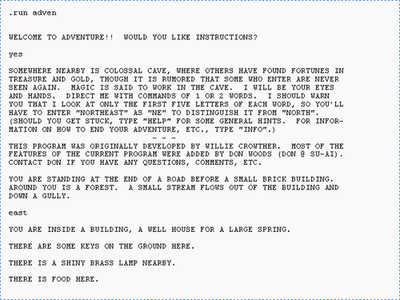
As Arthur Dent, the player types commands such as "look", "take screwdriver" or "put robe on hook" to solve puzzles and collect items. Most commands advance a turn counter, and some puzzles must be solved within a set number of turns or the game ends. Once Arthur has the Guide itself, he can look up a wide range of topics, some of which help with the puzzles.
The game loosely follows the first book. Arthur's house is about to be demolished for a bypass, and his friend Ford Prefect, secretly an alien, gets them aboard a Vogon ship just before the Earth is destroyed for a hyperspace bypass. After Vogon poetry and the airlock, they are rescued by the Heart of Gold, stolen by Galactic President Zaphod Beeblebrox, with Trillian aboard. While the others retire to the sauna, Arthur is left to get the ship to Magrathea, using the Infinite Improbability Drive to slip into the pasts of Ford, Zaphod and Trillian and bring back items that eventually let the Nutrimatic make real tea. The game ends as the crew is about to set foot on Magrathea.
Making The Hitchhiker's Guide to the Galaxy
Series creator Douglas Adams designed the game with Infocom's Steve Meretzky, and it was released in 1984 for the Apple II, Mac, Commodore 64, CP/M, MS-DOS, Amiga, Atari 8-bit computers and Atari ST, Infocom's fourteenth game. Adams said the difficulty of the Babel Fish puzzle was intentional: "Just as the player gets comfortable in the narrow neck, the bottom drops out!" Jerry Pournelle warned that "even if you've memorized the book, these puzzles are hard".
It sold 59,000 copies in 1984, second only to Zork I among Infocom games, and 166,000 in 1985, the company's best seller that year; it passed 250,000 by November 1989 and ultimately sold 400,000. Compute! suggested it "may well be Infocom's best effort to date", and Computer Gaming World ranked it 42nd among the best games of all time in 1996. A sequel, Milliways: The Restaurant at the End of the Universe, was in trouble from its start in 1985 and was cancelled in 1989.
The Hitchhiker's Guide to the Galaxy Trivia
- Getting a Babel Fish out of a dispenser takes a chain of obscure actions within a turn limit; Infocom sold T-shirts reading "I got the Babel Fish!".
- Failing the Babel Fish puzzle does not kill the player but makes the game unwinnable, since a later code needs Vogon translated.
- Its feelies included a "Don't Panic!" badge, pocket fluff, Peril Sensitive Sunglasses, an empty bag of microscopic space fleet, and "no tea".
- Computer Gaming World reported rumours that important people in the industry could not get out of the first room.
- The BBC's 2004 20th Anniversary Edition, illustrated by Rod Lord, won an Interactive BAFTA.