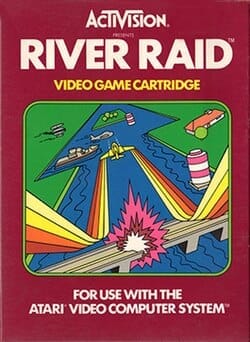
River Raid
1982 · Shooter · Atari 2600
Overview
River Raid (1982) is Carol Shaw's Atari 2600 shooter for Activision: fly up a river, destroying ships, helicopters and bridges while refuelling on the way.
Deep Dive
River Raid flies a jet up a vertically scrolling river, shooting tankers, helicopters, jets and bridges while avoiding the banks. Fuel runs down constantly and is replenished by flying over fuel depots — which can also be shot for points, a choice the player makes over and over. Carol Shaw generated the river with an algorithm rather than storing it, producing a long, varied course within the 2600's tiny memory. It was one of Activision's best-sellers and among the most acclaimed games on the system.
Developer Story
River Raid was programmed by Carol Shaw at Activision in 1982. Shaw was one of the very few women working as a game programmer in the early 1980s and had previously worked at Atari. She designed the procedurally generated river using a clever algorithm that produced different terrain every game while maintaining playable structure. River Raid was one of Activision's best-selling titles and demonstrated that procedural generation could create compelling replayable content.
Did You Know?
- Carol Shaw was one of the first female professional game programmers — River Raid was her masterpiece and one of the best-reviewed 2600 games ever made.
- The river was procedurally generated using a seed algorithm — each section was different but the game always remained playable.
- Fuel management was core to the design — players had to weigh speed (reaching fuel depots faster) against caution (avoiding being shot).
- River Raid was banned in West Germany for supposedly training children in military strategy and war skills.
- Shaw programmed the 2600's limited hardware so efficiently that the game ran at a smooth framerate other developers struggled to achieve.
Sources & further reading
- River Raid — Wikipedia