Pitfall!
1982 · Platform · Atari 2600
Overview
David Crane's 1982 Atari 2600 jungle adventure, in which Pitfall Harry swings on vines and dodges crocodiles hunting for treasure against a 20-minute clock.
Deep Dive
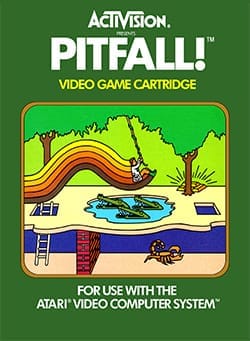
Pitfall! was designed by David Crane and published by Activision for the Atari 2600 in 1982. The player guides Pitfall Harry through a jungle in search of treasure, with 20 minutes to collect as much as possible. The jungle is full of hazards — pits, quicksand, rolling logs, crocodiles and scorpions — some costing points and others a life, and Harry jumps, climbs ladders and swings across gaps on vines. Its large world, smooth animation and run-and-jump design were remarkable for the 2600 and made it one of the most influential games on the console. It was later ported to the Atari 5200, Atari 8-bit computers, ColecoVision, Commodore 64 and MSX.
Developer Story
Pitfall! was designed by David Crane at Activision in 1982. Crane wrote the game in five and a half months and achieved a 16-bit-quality look on the Atari 2600 through expert hardware manipulation. Pitfall Harry was one of the first platformer protagonists with consistent visual personality — his animation was expressive and fluid. Pitfall! sold over 4 million copies, making it one of the best-selling games of the Atari era.
Did You Know?
- Crane hand-animated every frame of Pitfall Harry's movement to create fluid, expressive motion unusual for the Atari 2600.
- The game had 255 screens connected in a loop — players could complete it left-to-right or take a shortcut through underground tunnels.
- Pitfall! sold over 4 million copies, making it one of the best-selling games of the entire Atari 2600 era.
- The underground tunnels let players skip above-ground screens — finding the optimal route was a speedrunning puzzle built into the design.
- As an Activision game, Pitfall! credited Crane by name — Activision had been founded by programmers who left Atari partly because it refused to credit them.
Sources & further reading
- Pitfall! — Wikipedia