After Burner
1987 · Rail Shooter · Arcade
Overview
Sega's 1987 jet-fighter rail shooter, developed by Yu Suzuki's team: fly an F-14 Tomcat through 18 stages of missile lock-ons, ideally from a hydraulic cockpit that rolls with the plane.
Deep Dive
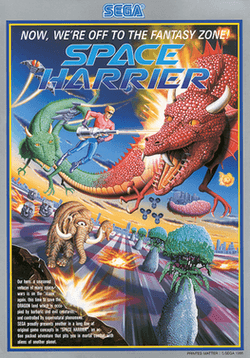
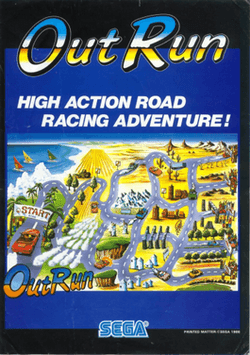
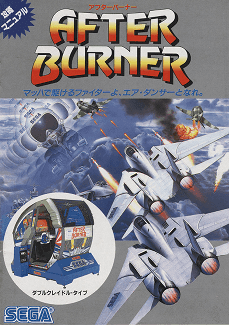
After Burner was developed by Sega's Studio 128 and released in arcades in 1987. The player flies an F-14 Tomcat through 18 stages, shooting down waves of enemy aircraft with a machine gun and a limited supply of heat-seeking missiles. Like Sega's earlier Space Harrier (1985) and Out Run (1986), it uses a third-person view from behind the player's vehicle, and it ran on the Sega X Board, hardware capable of rotating sprites and surfaces to sell the sense of speed and banking. Its most elaborate cabinet was a hydraulic "taikan" motion simulator — the fourth Sega game to use one, and more sophisticated than its predecessors — that tilted the seated player as the jet rolled.
Developer Story
After Burner was designed by Yu Suzuki at Sega in 1987. The third-person aerial dogfighting game used Sega's Super Scaler hardware at its most impressive — hundreds of enemy aircraft scaled and rotated at 60fps to simulate aerial combat. The hydraulic cabinet moved the entire cockpit in sync with the on-screen action. After Burner grossed more per machine than almost any game before it.
Did You Know?
- The hydraulic cabinet version of After Burner physically tilted the entire cockpit — one of the most elaborate arcade experiences ever built.
- After Burner used a real F-14 Tomcat as its visual basis, capitalising on the Top Gun film released the previous year.
- Machine-gun fire was unlimited, but missiles ran low and were restocked by mid-air refuelling between stages.
- Suzuki directed the production like a film — the missions followed a narrative arc with specific enemy formations for each stage.
Sources & further reading
- After Burner — Wikipedia