Adventure
1979 · Action-Adventure · Atari 2600
Overview
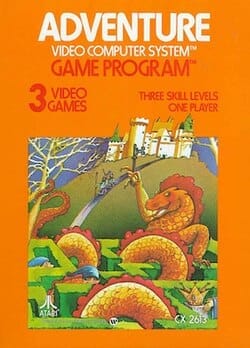
Adventure (1979) is Warren Robinett's Atari 2600 action-adventure — a graphical take on Colossal Cave, and home to the first known video game Easter egg.
Deep Dive
Adventure turned the text game Colossal Cave Adventure into pictures: players guide a square hero through castles, mazes and catacombs to return an enchanted chalice to the gold castle, collecting keys, a sword and a magnet while evading three dragons and a thieving bat. Atari did not credit its programmers, so Warren Robinett hid a secret room reading 'Created by Warren Robinett', reachable only by carrying a single hidden dot to the right wall. It became the first widely known Easter egg in a video game.
Developer Story
Adventure was programmed by Warren Robinett for the Atari 2600 in 1979. Atari's management told programmers not to include any credits in games — they feared developers would be poached. Robinett hid his name in a secret room: by carrying a specific dot to a specific wall junction, a hidden room appeared reading "Created by Warren Robinett." This was the first known Easter egg in a video game, and it sparked a tradition that continues to this day.
Did You Know?
- Adventure contained the first known Easter egg in a video game — Warren Robinett hid his name in a secret room because Atari forbade developer credits.
- The game was a graphical adaptation of Colossal Cave Adventure, condensed from a text game into the Atari 2600's 4KB of ROM.
- The dragon AI was based on a simple fleeing/chasing behaviour that Robinett developed — Yorgle the yellow dragon feared the gold key.
- A black dot hidden in one of the castles was the key to accessing the Easter egg room — players searched for it for years before discovering it.
- Robinett had already left Atari by the time a teenage player found the Easter egg in 1980, so the company could not simply ask him to remove it.
Sources & further reading
- Adventure (1980 video game) — Wikipedia