OXO
1952 · Puzzle · EDSAC
Overview
OXO (1952) is noughts and crosses on Cambridge's EDSAC computer, written by A. S. Douglas for a thesis on human-computer interaction — one of the first video games.
Deep Dive
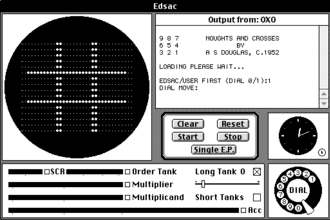
OXO played tic-tac-toe against a human opponent on the EDSAC, a room-sized computer at the University of Cambridge. Players entered moves with a rotary telephone dial, each digit mapping to one of the nine squares, and the board appeared on the machine's small display. The computer played a perfect game. Alexander Douglas wrote it in 1952 to illustrate his research into how people interact with machines, not as entertainment, and it was never distributed beyond the university — yet it stands as one of the earliest games to use a graphical display.
Developer Story
Alexander Douglas was a British academic who created OXO as part of his 1952 PhD thesis at the University of Cambridge on human-computer interaction. Douglas had no intention of building a game — he needed a demonstration program to illustrate his research points about how humans interact with machines. After completing his doctorate he returned to academia and never worked in the games industry.
Did You Know?
- OXO was never publicly distributed — it ran on the EDSAC computer at Cambridge, a machine that occupied an entire room and was only accessible to university researchers.
- Douglas used a rotary telephone dial as the input device, with numbers 1-9 mapping to the nine squares of the tic-tac-toe grid.
- The game always played optimally — it was impossible to beat if you were playing second, making it more of a demonstration than a competitive game.
- OXO is sometimes listed as the first video game with a graphical display, predating Tennis for Two and Spacewar! by several years.
Sources & further reading
- OXO (video game) — Wikipedia