The Sumerian Game
1964 · Strategy · IBM 7090
Overview
One of the first strategy games ever made: a text simulation of running an ancient Sumerian city-state, written for an IBM mainframe as an experiment in teaching schoolchildren with computers.
Deep Dive
The Sumerian Game grew out of a 1964–1966 research project by IBM and the Board of Cooperative Educational Services of Westchester County, New York, which wanted to know whether computer simulations could work as classroom tools. Mabel Addis, a fourth-grade teacher, designed it, and William McKay programmed it for the IBM 7090, a time-shared mainframe. Players ruled a Sumerian city, deciding each season how much grain to plant, store and feed to the population as land and resources changed. A group of 30 sixth-graders played the first version in 1964. A revised edition, with a sharper focus, more story and added audiovisual material, was tested on a second group of students in 1966. Its turn-based resource management makes it an ancestor of the city-building and strategy games that followed.
Developer Story
The Sumerian Game was created in 1964 by Mabel Addis, a school teacher, and William McKay, an IBM programmer, as an educational tool for sixth-grade students in Westchester County, New York. It is one of the earliest known educational computer games and one of the first games designed for children. Addis wrote the narrative and game design; McKay implemented it on an IBM 7090 mainframe. The project was funded by the Board of Cooperative Educational Services.
Did You Know?
- The Sumerian Game is considered one of the earliest known computer role-playing and strategy games, predating the commercial game industry by over a decade.
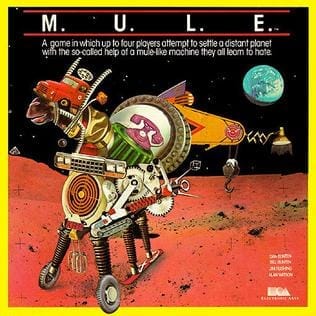
- Players managed grain supplies, population, and land in ancient Sumeria — economic simulation concepts that resurfaced in M.U.L.E., Civilization, and countless strategy games.
- It was played by typing commands on a teletype machine connected to a mainframe, with the computer printing responses in plain English.
- Mabel Addis was one of the first women to design a video game, doing so before the term "video game" even existed.
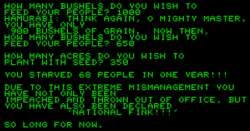
- The game later inspired Hamurabi (1968) and its many derivatives, making it an indirect ancestor of the entire resource management genre.
Sources & further reading
- The Sumerian Game — Wikipedia