Hogan's Alley
1984 · Light Gun Shooter · NES / Famicom
About Hogan's Alley
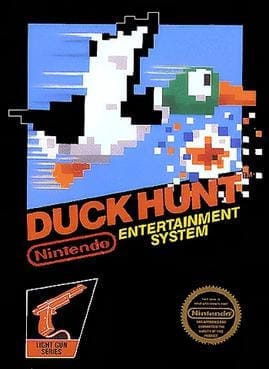
Hogan's Alley (1984) is Nintendo's light gun game in which players shoot cardboard gangsters while sparing innocent civilians, named after the FBI's training range and, with Duck Hunt, one of the first hit light gun video games.
Hogan's Alley in Depth
Each round begins with three cardboard cutouts sliding into position against a blank wall and turning to face the player, showing a mix of gangsters and innocent or friendly people, and the player must react quickly and shoot only the gangsters. In later rounds, the backdrop becomes a city block with five cutouts, some already exposed as they come into view. After five rounds of each, a bonus round gives a limited supply of ammunition to shoot up to ten tin cans thrown from one side, bouncing them onto ledges on the other side for points, with a bonus for unused shots; the game then returns to the wall at a faster speed. Shooting an innocent or failing to hit a gangster costs a life, and bonus lives come at set scores.
The NES version offers "Hogan's Alley A" with the blank wall, "Hogan's Alley B" with the town, and "Trick Shot", the can-shooting game with ten cans per round and unlimited ammunition. A "MISS" counter rises with each innocent shot, gangster missed or can dropped, and the game ends at ten.
Making Hogan's Alley
Nintendo released Hogan's Alley for the Famicom in 1984, then in 1985 as a Nintendo VS. System arcade Game Pak and as one of the 17 North American NES launch titles. The arcade version became popular in North America, popularising light gun games together with Duck Hunt, topped the RePlay arcade charts by November 1985, and was a very popular arcade game in Europe by 1986. Computer and Video Games called it "a pleasant change" from the space shooters then filling arcades, while noting its similarity to Sega's Bank Panic and that it might not appeal to everyone, and Computer Gamer praised its realistic gun controller. Computer Gaming World named it 1988's Best Target Game for the NES, calling it "an entertaining variation on the theme". A version using the Wii Remote in place of the Zapper came to the Wii U Virtual Console in North America on 7 January 2016.
Hogan's Alley Trivia
- Its namesake range was built at Camp Perry, Ohio, in the 1920s and redesigned for the FBI Academy at Quantico in 1954.
- Three years after the game, the FBI built a new Hogan's Alley at Quantico resembling a small town.
- Artist Cory Arcangel hacked it into "I Shot Andy Warhol", replacing the targets with Warhol.
- Hogan's Alley-inspired games appear in the WarioWare series.
- In Super Smash Bros., the Duck Hunt character kicks its tin can, which an off-screen Zapper keeps shooting until it explodes.
Sources & further reading
- Hogan's Alley (video game) — Wikipedia