Hellfire
1989 · Horizontal Shooter · Arcade
About Hellfire
Hellfire (1989) is Toaplan's first horizontal shoot 'em up, developed alongside Truxton, in which a pilot switches between four fixed-direction weapons to attack a robot dictator's Black Nebula, and whose engine was reused for Zero Wing.
Hellfire in Depth
In 2998, as humanity spreads peacefully through space, a mysterious matter called the Black Nebula engulfs star after star, the work of Super Mech, a robot dictator from the far reaches of space. Space Federation member Captain Lancer launches a surprise attack in the only available fighter, the CNCS1, armed with Hellfire, the strongest weapon in the galaxy. Over six increasingly difficult levels, each with a boss, the background scrolls constantly until the boss is reached.
Its distinctive feature is the weapon system: four main weapons, upgraded with "P" icons, each firing in a fixed direction however the ship moves, switched with a change button. Speed-ups and "B" icons worth points, vital for extra lives, can also be collected. Depending on the arcade settings, a downed player restarts from a checkpoint or respawns on the spot, and losing a life resets the ship's firepower and speed. As in earlier Toaplan games, completing the last stage loops back to the first with denser bullet patterns. The Genesis version turned Hellfire itself into a screen-clearing bomb and added a shield and an option, while the PC Engine Hellfire S replaced Lancer with a heroine, Kaoru, whose ending sees her sacrifice herself to save Earth.
Making Hellfire
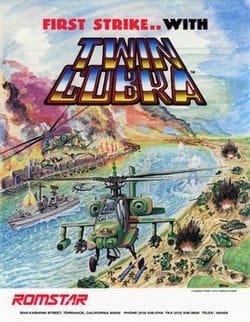
Uemura, whose earlier Toaplan work included Tiger-Heli, Flying Shark and Twin Cobra, led it as an experiment in bringing Toaplan's style to a Gradius-like horizontal format, developed in parallel with Truxton. Its development was troubled by inexperience, and both single-player and co-op versions were planned from the start because of pressure to make two-player games; Kōetsu Iwabuchi drew the artwork. Taito released it in Japan and U.S.A. Games in North America in October 1989. Critics received it positively, though some compared it to R-Type. NCS Corporation ported it to the Genesis in 1990, with much the same staff, released by Masaya in Japan, Seismic in North America and Sega in Europe, and MegaTech called it "a slick and very good looking blaster which oozes playability". NEC Avenue's Hellfire S for the PC Engine Super CD-ROM² followed in April 1991 with an orchestral soundtrack and animated cut-scenes. Toaplan's second and last horizontal shooter, Zero Wing, used the same engine.
Hellfire Trivia
- It was one of the first Toaplan releases to feature the company's name prominently.
- Designer Tatsuya Uemura, a former composer, asked for a puzzle element to be included.
- The team found terrain and collision detection frustrating, as their vertical shooter experience did not carry over.
- Mega ranked the Genesis version fourth among the top Mega Drive games of all time.
- Its rights belong to Tatsujin, a company named after Truxton's Japanese title.
Sources & further reading
- Hellfire (video game) — Wikipedia