Galaxy Game
1971 · Space Combat · PDP-11 Arcade Cabinet
Overview
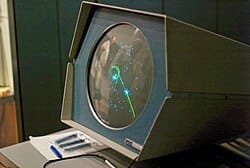
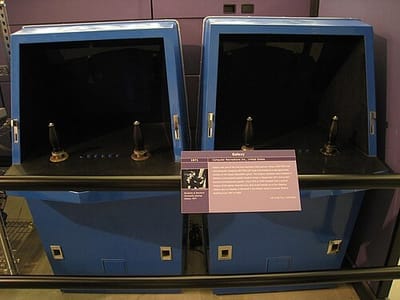
A coin-operated version of Spacewar! installed at Stanford University in 1971, which, alongside Computer Space, has a claim to be one of the very first arcade video games.
Deep Dive
Galaxy Game was built in 1971 by Bill Pitts and Hugh Tuck, who took the 1962 computer game Spacewar! — one of the earliest games to spread between computer installations — and expanded it into a coin-operated machine driven by a PDP-11 minicomputer. Two players each fly a ship, "the needle" or "the wedge", and fight a dogfight while the gravity of a central star pulls them both in. Unlike the mass-produced Computer Space of the same year, Galaxy Game was a hand-built installation, and it remains a key exhibit in the earliest history of arcade games.
Developer Story
Galaxy Game was built by Stanford students Bill Pitts and Hugh Tuck in 1971 — just months before Computer Space. The pair spent $20,000 of their own money to build a coin-operated Spacewar! machine using a PDP-11 minicomputer, which was enormously expensive at the time. It was installed in the Tresidder Union at Stanford and a second, improved version ran there until 1979. Because it was never commercially manufactured, only two units were ever built.
Did You Know?
- Galaxy Game may have been the first coin-operated video game, installed at Stanford slightly before Computer Space reached arcades — the exact timeline is disputed.
- The PDP-11 computer at its core cost around $14,000 alone, making each play of the game extraordinarily expensive to provide.
- It allowed up to eight players to queue and watch each other play, creating an early spectator gaming culture around the machine.
- The original cabinet is preserved at the Computer History Museum in Mountain View, California.
- Pitts and Tuck never commercialised the design — they built it as an engineering project, not a business venture.
Sources & further reading
- Galaxy Game — Wikipedia