Taito
Japan · Founded 1953 · 1953 – present
Taito launched the global video game industry with Space Invaders in 1978, the single most commercially significant arcade game ever made, and followed it with Bubble Bobble, Arkanoid, Elevator Action, and Qix — a portfolio that shapes arcade design vocabulary to this day.
Taito was founded in Tokyo in 1953 by Michael Kogan, a Ukrainian-born Jewish immigrant who had settled in Japan, initially as an importer of American products including jukeboxes and vending machines. The company entered amusement devices in the 1960s and produced electromechanical arcade games before transitioning to video games in the mid-1970s with simple titles derived from Western designs. The staff engineer Tomohiro Nishikado was given responsibility for developing the company's first original video game concept in 1977, and his research and development produced Space Invaders. Space Invaders (1978) was the first video game phenomenon at global scale. Nishikado designed the descending alien formation, the mystery ship bonus, and the player-driven shield destruction in response to technical limitations rather than design choices — the hardware could not move the aliens faster than the row count dictated, so fewer aliens meant faster movement, creating accelerating difficulty that was an emergent property of the code rather than an intentional design decision. The game cleared pachinko parlours of their machines to accommodate demand in Japan; in the United States, Midway's licence became the first arcade game to earn over $1 billion. Taito manufactured 100,000 Space Invaders cabinets in its first year — an unprecedented production run. The subsequent Taito arcade catalogue built on Space Invaders' success with designs of lasting influence. Galaxian (1979, released by Namco but competitive with Taito's products) prompted Taito's Space Invaders response titles, while the company's own Qix (1981) introduced an area-capture mechanic that no previous game had used and which spawned its own genre of imitations. Elevator Action (1983) was one of the earliest action games to use a building setting with multiple floors, directly anticipating the vertical exploration of later action games. Arkanoid (1986) refined the Breakout paddle-game formula to its definitive form, adding power-ups, multiple level layouts, and a framing narrative. Bubble Bobble (1986) was Taito's most beloved design achievement after Space Invaders: a cooperative two-player platform game in which dragons trapped enemies in bubbles and popped them, with secret items, multiple difficulty paths, and a true ending accessible only through cooperative play. The game's character design — the dragons Bub and Bob, rendered in a round, childlike style — gave Taito characters with genuine personality that had been absent from the company's earlier, more abstract titles. Rainbow Islands (1987) and Parasol Stars (1991) extended the Bubble Bobble cast into further adventures. The Darius series, beginning in 1987, was a technically ambitious horizontal shoot-'em-up presented on a three-monitor widescreen cabinet that was a landmark of arcade spectacle. Square Enix acquired Taito in 2005, and the company continues to operate as a developer and publisher within the Square Enix group. Its historical catalogue — particularly Space Invaders and Bubble Bobble — has been continuously re-released and reinterpreted across every subsequent platform generation.
- Space Invaders (1978)
- Qix (1981)
- Jungle Hunt (1982)
- Elevator Action (1983)
- Arkanoid (1986)
- Bubble Bobble (1986)
- Rainbow Islands (1987)
- Darius (1987)
- Founded 1953 by Ukrainian-born Michael Kogan in Tokyo as an importer of American goods
- Space Invaders (1978) cleared pachinko parlours across Japan to accommodate demand; first arcade game to earn over $1 billion
- Space Invaders' accelerating difficulty was an emergent property of its hardware limitations, not intentional design
- Acquired by Square Enix in 2005; continues operating as a subsidiary
13 Games in Archive
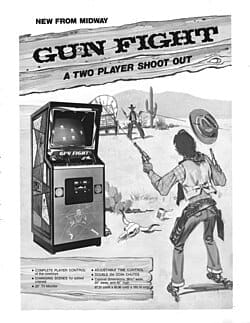
Gun Fight
Arcade

Space Invaders
Arcade
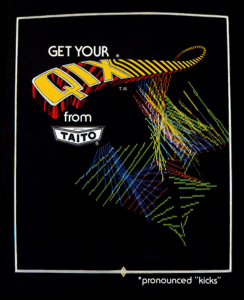
Qix
Arcade

Arkanoid
Arcade

Bubble Bobble
Arcade

Double Dragon
Arcade

Operation Wolf
Arcade

Rastan
Arcade

Twin Cobra
Arcade

Darius
Arcade

Parasol Stars: The Story of Bubble Bobble III
TurboGrafx-16

Lufia II: Rise of the Sinistrals
SNES

Little Samson
NES