Midway Games
USA · Founded 1958 · Closed 2009 · 1973 – 2009
Midway was the American arcade publisher responsible for Pac-Man, Mortal Kombat, NBA Jam, and Defender — a company that shaped the coin-op golden age through its partnership with Namco and its own design team before a long decline ended in bankruptcy.
Midway Manufacturing was founded in Chicago in 1958 as a pinball and amusement device manufacturer, entering the video game business in 1973 when it licensed Atari's Pong and produced its own table-tennis variant called Winner. The company's business model through much of the 1970s was built on licensing and distributing Japanese arcade games for the American market — a role that made it the conduit for some of the most commercially significant titles in arcade history. Midway distributed Taito's Space Invaders in the United States (1978), Namco's Pac-Man (1980), and Namco's Galaga (1981) — three of the four best-selling arcade games of all time — without having developed any of them. The American public knew these games as Midway games, and the company's brand acquired an authority that its development output alone would not have supported. Midway's internal development team, operating from its Chicago manufacturing facility, produced its own original titles alongside the licensed imports. Defender (1981), designed by Eugene Jarvis, was technically the most demanding game in early arcade history: two-directional scrolling on an asymmetric playfield, radar display, simultaneous tracking of multiple enemy types and human targets, and a six-button control panel that required genuine skill to operate. Defender was commercially successful despite — or because of — its difficulty, and established Midway's internal studio as capable of original design at the highest level. Robotron: 2084 (1982), also by Jarvis, introduced the twin-stick shooter control scheme that would eventually define an entire genre on home consoles. Mortal Kombat (1992), designed by Ed Boon and John Tobias, was Midway's most culturally significant original creation: a fighting game that used digitised photographs of real actors as sprites, producing realistic-looking violence that triggered congressional hearings and the creation of the ESRB rating system. The game's Fatality finishing moves — brutal, specific, character-dependent kill animations — became the most discussed element of any arcade game since Pac-Man and drove the coin-op's commercial success far beyond its gameplay merits alone. NBA Jam (1993), designed by Mark Turmell, was the highest-earning arcade game of 1993 and introduced a two-on-two basketball format with exaggerated physics and celebrity cameo codes that made it one of the most broadly appealing arcade games ever produced. Midway's transition to console and PC publishing in the mid-1990s was financially mixed. The company went public in 1996 and produced a stream of coin-op conversions and original titles across PlayStation and Nintendo 64 platforms, but the transition from arcade publisher to multiplatform developer proved difficult to manage. The company sold its pinball division in 1999 and acquired several studios in an attempt to build console development capacity, but the resulting output — including the Mortal Kombat sequels, Hydro Thunder, and NFL Blitz — rarely matched the sales levels the company needed to service its debts. Midway filed for Chapter 11 bankruptcy protection in February 2009 and was liquidated; Warner Bros. Interactive Entertainment acquired most of its intellectual property, including Mortal Kombat, which it continues to develop.
- Defender (1981)
- Robotron: 2084 (1982)
- Pac-Man (US distribution, 1980)
- Galaga (US distribution, 1981)
- Mortal Kombat (1992)
- NBA Jam (1993)
- NFL Blitz (1997)
- Hydro Thunder (1999)
- Distributed Space Invaders, Pac-Man, and Galaga in the USA — three of the four highest-grossing arcade games ever made
- Defender (1981) by Eugene Jarvis was the most technically demanding coin-op of the early arcade era
- Mortal Kombat (1992) triggered the congressional hearings that directly created the ESRB game rating system
- Filed for Chapter 11 bankruptcy in February 2009; Warner Bros. acquired the IP including Mortal Kombat
13 Games in Archive
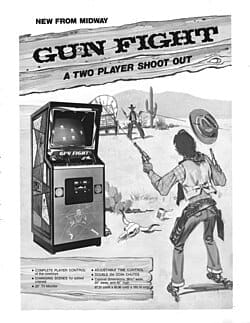
Gun Fight
Arcade

Sea Wolf
Arcade

Ms. Pac-Man
Arcade

Gorf
Arcade

Wizard of Wor
Arcade

Tron
Arcade

BurgerTime
Arcade

Spy Hunter
Arcade

Tapper
Arcade

Rampage
Arcade

Mortal Kombat
Arcade

NBA Jam
Arcade

Mortal Kombat II
SNES