Atari
USA · Founded 1972 · Closed 1984 · 1972 – 1984
The original Atari, founded by Nolan Bushnell and Ted Dabney in 1972, created the commercial video game industry with Pong, defined the home console market with the 2600, and produced the most valuable entertainment company in the world before a catastrophic collapse in 1983.
Atari was founded in June 1972 by Nolan Bushnell and Ted Dabney in Sunnyvale, California, with $250 and a concept borrowed from the Magnavox Odyssey's tennis game. Bushnell assigned the implementation to young engineer Allan Alcorn as a training exercise; Alcorn's implementation of Pong was so playable that when Bushnell placed a prototype in Andy Capp's Tavern in Sunnyvale, the machine jammed within two weeks because the coin box was full. Atari manufactured Pong themselves — an unusual decision for a startup — and sold 19,000 units in 1973. The game launched an industry: Midway, Williams, Taito, and Namco all entered the coin-operated video game market within two years of Pong's success. Bushnell sold Atari to Warner Communications in 1976 for $28 million, giving the company the capital to develop the Video Computer System (later renamed the Atari 2600), which launched in 1977. The 2600 used a MOS 6507 CPU, 128 bytes of RAM, and ROM cartridges — the first mass-market implementation of the cartridge model that would define home gaming for the next decade. Early sales were modest, but the 1980 licensing of Space Invaders as a 2600 exclusive quadrupled console sales in a single year and demonstrated that arcade-to-home conversion was the most powerful driver of hardware adoption. By 1982, Atari's revenues exceeded $2 billion, and the company was the fastest-growing in American history. Atari was worth more than General Motors on a per-employee basis. The peak years between 1980 and 1982 produced the foundational titles of Atari's golden era: Space Invaders (licensed, 1980), Asteroids (1981), Missile Command (1981), Defender (licensed, 1982), and Pitfall! (published by Activision, 1982). Atari's own in-house development — the Atari 800 computer and the 5200 console — produced sophisticated software for audiences willing to invest in more capable hardware. The company also operated the coin-op division that had started the business, producing Asteroids (1979), Missile Command (1980), Tempest (1981), and Centipede (1980) — each a different expression of what arcade hardware could do in the early 1980s. Tempest in particular demonstrated vector graphics capabilities that raster-display competitors could not approach. The collapse was rapid and almost total. Warner Communications, under pressure from shareholders expecting continued growth, greenlit a $25 million payment for the rights to develop a 2600 game based on the film E.T. the Extra-Terrestrial, with a five-week development window to meet the 1982 Christmas market. The resulting game, developed by Howard Scott Warshaw under extraordinary time pressure, was commercially disastrous — millions of cartridges were returned unsold and approximately 700,000 were buried in a New Mexico landfill, a story that became the symbol of the 1983 crash. Combined with the disastrous reception of the 2600 Pac-Man port (which sold seven million copies but was so inferior to the arcade original that it drove consumer confidence below the breaking point), Atari lost $536 million in 1983 and effectively collapsed. Warner sold the consumer division to Jack Tramiel in 1984; the original Atari ceased to exist as a coherent entity. Atari's legacy is the creation of the commercial video game industry and the demonstration of both its extraordinary growth potential and its structural vulnerability to quality collapse. The company that made $2 billion in revenue in 1982 was extinct as a creative force by 1984. Its lesson — that consumer confidence in a platform is fragile and can be destroyed by a critical mass of poor-quality product — shaped every platform holder's quality control strategy that followed.
- Pong (1972)
- Breakout (1976)
- Asteroids (1979)
- Missile Command (1980)
- Centipede (1980)
- Tempest (1981)
- Defender (1980, licensed from Williams)
- Space Invaders (1980, licensed from Taito)
- Founded June 1972 by Nolan Bushnell and Ted Dabney; first Pong cabinet jammed from too many coins within two weeks
- Sold to Warner Communications in 1976 for $28 million; reached $2 billion revenue by 1982
- Space Invaders (1980) 2600 licence quadrupled console sales in a single year
- Lost $536 million in 1983; Warner sold consumer division to Jack Tramiel in 1984
38 Games in Archive

Pong
Arcade

Space Race
Arcade

Gotcha
Arcade

Gran Trak 10
Arcade

Night Driver
Arcade

Sprint 2
Arcade

Breakout
Arcade

Atari Football
Arcade

Fire Truck
Arcade

Asteroids
Arcade
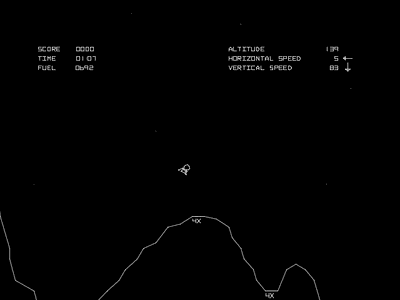
Lunar Lander
Arcade

Adventure
Atari 2600

Missile Command
Arcade

Battlezone
Arcade

Centipede
Arcade

Warlords
Arcade

Tempest
Arcade

Pole Position
Arcade

Dig Dug
Arcade

Millipede
Arcade

Gravitar
Arcade

Star Wars
Arcade

Crystal Castles
Arcade

Paperboy
Arcade

Gauntlet
Arcade

Road Blasters
Arcade

Toobin'
Arcade

Klax
Arcade

Gauntlet II
Arcade

MIDI Maze
Atari ST

California Games
Atari Lynx

Chip's Challenge
Atari Lynx