Ultima
Origin Systems · Since 1981
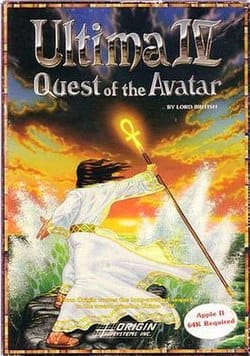
Richard Garriott's Ultima series invented the open-world RPG with ethical stakes, NPC schedules, and player-driven narrative. Ultima IV's virtue system — where the goal was to embody moral principles rather than defeat a villain — was the most radical design departure in RPG history.
The Ultima series (1981–1999) represents the most sustained single-developer experiment in role-playing game design in the medium's history. Richard Garriott, operating under the pseudonym Lord British, developed each numbered entry as a reinvention rather than an iteration: Ultima I through III built the foundation; Ultima IV abandoned the villain-defeat structure entirely in favour of virtue embodiment; Ultima V explored the political consequences of the virtues Ultima IV had established; Ultima VI questioned the racial prejudice underlying the previous games' treatment of gargoyles. Ultima VII (1992) achieved the closest approximation of a truly living world that 1990s technology could produce: individually modelled objects, NPCs with daily schedules and inter-personal relationships, an economy where player actions had consequences on local commerce. The game shipped with a cloth map — a tactile object that enhanced immersion — and required the player to read in-game books to understand the world rather than having it explained directly. It remains the benchmark for open-world RPG depth. Ultima Online (1997) extended Garriott's world-building ambitions into the first commercially successful massively multiplayer online RPG, hosting thousands of simultaneous players in Britannia. The experiment revealed the gap between idealistic simulation design and actual player behaviour: the game's planned ecology collapsed within hours of launch as players optimised the virtual economy and ecology beyond the designers' predictions. The lessons learned in Ultima Online's early months shaped every MMORPG that followed it.