Action Games
Fast reflexes, high stakes — the foundation of video game design

License: CC BY-SA 3.0
| Commercial catalyst | Space Invaders (Taito, 1978) |
| US arcade revenue, 1982 | $8 billion+ |
| Broadest sub-genres | Shmups, Platformers, Fighting |
| Core design concept | Flow state (Csikszentmihalyi) |
Action games are fast-paced games demanding quick reflexes and real-time decision making. The broadest and most commercially dominant genre in gaming, action games established the visual and mechanical grammar that nearly every other genre builds upon.
Overview
Action games are games where success depends primarily on the player's physical reflexes and hand-eye coordination in real time, rather than planning or puzzle-solving. They respond to input immediately, create instant consequences for every decision, and present escalating challenge through increasing enemy speed, density, or attack complexity. Action is video gaming's broadest and most commercially dominant genre — shoot 'em ups, platformers, and fighting games are all sub-genres — and its default mode: most games, regardless of primary genre, incorporate action mechanics in some form.
History
The action game crystallised with Space Invaders (Taito, 1978) — the archetype of the core action loop: fast responsive input, escalating enemy pressure, lives as resilience measure, score as mastery measure. When Taito struggled to press enough 100-yen coins to meet demand in Japan, the scale of the phenomenon became clear. In North America, licensed to Midway, it fundamentally changed how businesses thought about interactive entertainment.
Atari's Centipede (1980) and Missile Command (1980) refined the formula. Dave Theurer designed Missile Command — defending cities against nuclear warheads — while reportedly suffering recurring nightmares about nuclear war during development. The game's impossible-to-win design (the missiles always eventually overwhelm the defences) built genuine dread into a score-attack structure.
Williams' Defender (1981) represented action game design at peak complexity: a scrolling planet, humanoids to protect, five simultaneous controls, and wave after wave of escalating enemies. Briefly the highest-grossing arcade game ever made, it attracted players who found simpler games insufficiently demanding. Its difficulty was part of the appeal.
The isometric perspective opened new dimensions. Sega's Zaxxon (1982) used forced perspective to create convincing 3D space. Q*bert (1982) combined isometric movement with colour-changing puzzle logic. Donkey Kong Jr. (1982) introduced climbing and swinging that diversified action movement beyond running and jumping.
Mechanics
Action game design rests on three pillars: control (tight, responsive input that rewards mastery), feedback (immediate visual and audio response to every player action), and escalation (increasing challenge that creates a continuous growth curve matching player skill). Lives and continues manage difficulty accessibility; score systems motivate replay and competition. The best action games create what psychologist Mihaly Csikszentmihalyi called "flow state" — a condition where challenge precisely matches skill, producing deep absorption and intrinsic satisfaction.
Cultural Impact
US arcades generated over $8 billion in 1982 — more than Hollywood box office and recorded music combined — almost entirely from action games. Space Invaders, Pac-Man, Donkey Kong, and Defender were the four pillars of this golden age. The psychological concepts action games pioneered — flow state, challenge-skill balance, variable reward schedules — became the foundational vocabulary of game design as an academic and professional discipline. Every game that asks you to react fast, survive pressure, and improve through repetition stands on the tradition built in arcades between 1978 and 1985.
22 Games in Archive
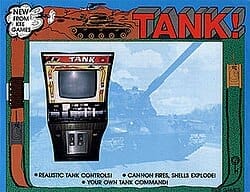
Tank
Arcade
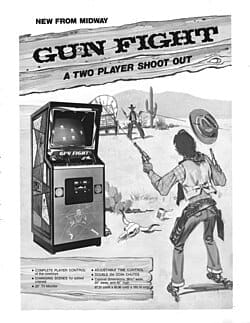
Gun Fight
Arcade

Sea Wolf
Arcade

Blockade
Arcade

Breakout
Arcade

Circus
Arcade

Crazy Climber
Arcade

Warlords
Arcade

Frogger
Arcade

Tron
Arcade

Dig Dug
Arcade

BurgerTime
Arcade

Mr. Do!
Arcade
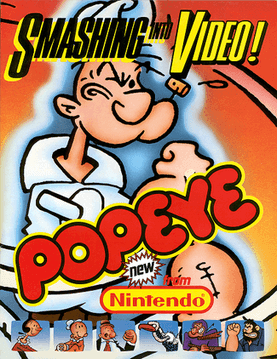
Popeye
Arcade

Crystal Castles
Arcade

Tapper
Arcade

Dragon's Lair
Arcade

Paperboy
Arcade

Arkanoid
Arcade

Rampage
Arcade

Metal Gear
MSX2 / NES

Head Over Heels
ZX Spectrum / Multiple