Sports Games
From Tennis for Two to simulation — the genre that launched the industry

License: CC BY-SA 3.0
| First electronic sports game | Tennis for Two (1958) |
| First commercial success | Pong (Atari, 1972) |
| Pong cabinets sold in 1974 | 19,000+ |
| Annual franchise pioneer | EA Sports (from 1983) |
Sports games simulate athletic competition. Pong (1972) — a simplified game of table tennis designed as a training exercise — became the first commercially successful video game and launched the entire industry. Sports games drove console adoption for decades and established the annual franchise model.
Overview
Sports games simulate the rules, challenge, and excitement of athletic competition. They span arcade abstractions — where three buttons represent all of basketball — to detailed simulations modelling real athletes' statistics, pitch physics, and coaching strategy. No other genre has been more important to the commercial history of video games: sports games drove console adoption, created the annual franchise release model, and — through Pong — launched the entire industry.
History
Tennis for Two (1958), created by physicist William Higinbotham at Brookhaven National Laboratory, is often cited as the first interactive electronic game. Displayed on an oscilloscope at a public open house, it showed a sideways tennis court with a ball following a realistic parabolic arc. Higinbotham had no commercial ambitions — he simply wanted something more interesting than static displays. Over 400 visitors played it on the day.
Atari's Pong (1972) was deliberately simple. Allan Alcorn designed it as a training exercise assigned by Nolan Bushnell — a ball bouncing between two paddles. Bushnell deployed a prototype in a Sunnyvale bar; it broke down within weeks because the coin box had overflowed. Atari sold 19,000 Pong cabinets in 1974 alone. The home version, released through Sears in 1975, sold 150,000 units in its first year. Pong proved the home market existed.
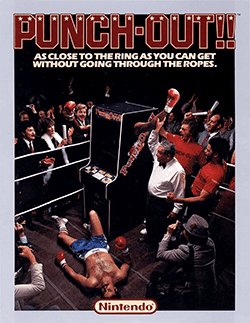
Sports titles multiplied through the late 1970s and early 1980s. Football (Atari, 1978) rendered players as Xs and Os on a top-down field — the first American football video game. Mattel's Intellivision launched with baseball and football simulations designed to outclass Atari. Activision Tennis (1981) impressed reviewers with physics quality that seemed impossible on the 2600's hardware. Nintendo's Mike Tyson's Punch-Out!! (1987) transformed boxing into a pure pattern-recognition challenge, becoming one of the NES's most beloved titles.
Mechanics
Sports games face a fundamental design tension: real sports are performed by trained athletes whose physical capabilities cannot be replicated by pressing buttons. Great sports game design abstracts skill into learnable mechanics — timing windows, trajectory prediction, strategic decisions — that create genuine mastery. Arcade sports games prioritise accessibility and spectacle; simulation sports games prioritise fidelity. The best examples of both styles achieve deep engagement through entirely different means.
Cultural Impact
Pong is the origin myth of video games — the demonstration that interactive electronic entertainment could be commercially viable, that consumers would pay to play at home, and that simple competitive mechanics have universal appeal. The sports franchise model pioneered by EA Sports — licensed athletes, annual roster updates, incremental improvements — became the most commercially reliable strategy in gaming history. FIFA/EA FC, Madden, and NBA 2K consistently rank among the top-selling titles worldwide every year, and this model of continuous annual engagement traces its lineage directly back to those first digital sports simulations of the 1970s and 1980s.