Racing Games
Speed, skill, and hardware innovation — the arcade's most spectacular genre

License: CC BY-SA 4.0
| First racing video game | Gran Trak 10 (Atari, 1974) |
| First 3D perspective | Night Driver (Atari, 1976) |
| Top-grossing NA arcade, 1983 | Pole Position (Namco) |
| Key developers | Namco, Sega (Yu Suzuki), Atari |
Racing games simulate vehicular competition. From Gran Trak 10's first digital circuit in 1974 to Pole Position's photorealistic Fuji Speedway in 1982, the genre drove some of the most spectacular hardware innovations in arcade history and created the most immersive cabinet experiences of their era.
Overview
Racing games simulate the experience of piloting vehicles in competitive or time-trial formats. The genre has consistently driven hardware innovation: arcade racing games pioneered sprite scaling, super scaler technology, force-feedback steering wheels, and 3D polygon rendering long before these technologies reached home computers. The physical arcade cabinet — wheel, pedals, seat — made racing games uniquely immersive, transforming a game into a full-body experience unmatched by any other genre.
History
Electromechanical driving arcade machines predate video games entirely. Sega's cabinet games of the 1960s and Chicago Coin's Speedway (1969) used mechanical displays driven by gears and motors. Atari's Gran Trak 10 (1974) brought racing to a digital raster monitor with a top-down track, steering wheel, and gear shift — inputs that justified the full cabinet format.
Night Driver (Atari, 1976) pioneered first-person perspective racing — white roadside markers rushing toward the player simulated forward motion convincingly. Turbo (Sega, 1981) used a dedicated custom chip for sprite scaling to create genuine speed sensation. Namco's Pole Position (1982) established the definitive template: a real racing circuit (Fuji Speedway), qualifying laps, competitor cars, and spectacular crashes. Pole Position was the highest-grossing arcade game in North America in 1983.
Sega's Hang-On (1985), designed by Yu Suzuki, introduced a motorcycle cabinet players physically leaned to steer. Using Sega's new Super Scaler hardware running at 60 fps, it created a sense of speed that home technology couldn't match for a decade. Suzuki followed with OutRun (1986) — racing as lifestyle fantasy, with branching routes, a passenger girlfriend, and a radio-cassette soundtrack whose three tracks players chose at the start.
Mechanics
Arcade racing games balance speed illusion against mechanical simplicity. Rubber-band AI — opponents that accelerate when the player pulls ahead — keeps races competitive regardless of skill level. Checkpoint systems and time limits create urgency without frustrating beginners. The mastery ceiling involves racing line memorisation and braking point optimisation. Simulation racing games (flourishing on home computers from the late 1980s) replaced arcade accessibility with realistic tyre models, gear management, and physics that rewarded genuine driving knowledge.
Cultural Impact
Racing games were responsible for the most spectacular hardware in arcade history. Sega's super scaler boards, Namco's System 21 polygon hardware (powering Winning Run in 1988 — the first polygon racing game), and the force-feedback steering wheel became the calling cards of the premium arcade experience. Yu Suzuki's OutRun remains a beloved object of 1980s nostalgia: its Ferrari Testarossa, its branching routes, and its three-song soundtrack have been re-released, remixed, and celebrated repeatedly in the decades since. Pole Position's television-style presentation — camera panning across the starting grid, a voiced announcer — established racing games as the genre most committed to cinematic spectacle.
15 Games in Archive

Space Race
Arcade

Gran Trak 10
Arcade

Night Driver
Arcade

Sprint 2
Arcade

Death Race
Arcade

Fire Truck
Arcade
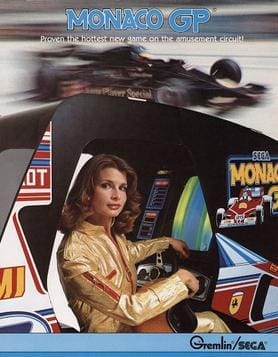
Monaco GP
Arcade

Rally-X
Arcade

Pole Position
Arcade

Spy Hunter
Arcade

Excitebike
NES / Arcade

Out Run
Arcade

Road Blasters
Arcade

Hang-On
Arcade / Sega Master System

City Connection
Arcade