Puzzle & Maze Games
Logic, patterns, and labyrinths — gaming's most universal appeal
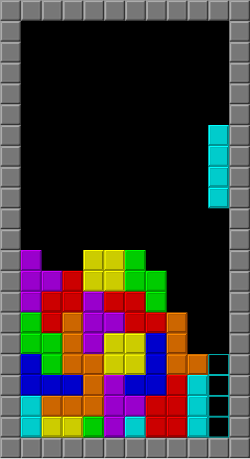
License: Public Domain
| Most iconic maze game | Pac-Man (Namco, 1980) |
| Best-selling puzzle game | Tetris (500M+ across platforms) |
| Tetris creator | Alexey Pajitnov, 1984–85 |
| Pac-Man cabinets sold | 400,000+ worldwide |
Puzzle and maze games challenge players with spatial reasoning and logic. Pac-Man transformed maze navigation into a global cultural phenomenon. Tetris became the most widely played game in history. The genre's elegant simplicity achieves universal appeal across ages and cultures like no other.
Overview
Puzzle games challenge players with problems requiring logic, pattern recognition, and spatial reasoning rather than physical reflexes. Maze games add real-time pressure by placing threats — enemies with distinct AI behaviours — within navigational environments. The two sub-genres frequently converge: Pac-Man is simultaneously a maze navigation challenge and a pattern-recognition puzzle. Together they represent gaming's clearest proof that elegant, simple mechanics can achieve universal appeal across every demographic.
History
Maze games have roots in the earliest computing. Maze War (1973–74), developed at NASA Ames Research Center, was among the first first-person perspective games — players navigated a wire-frame maze shooting each other in what may be the first networked multiplayer game. The concept spread to PLATO, where multiple maze games offered early multiplayer experiences.
Pac-Man (Namco, 1980), designed by Toru Iwatani, reinvented the maze game. Iwatani deliberately designed a game to attract women and couples to arcades — spaces dominated by Space Invaders' military aesthetics. He succeeded beyond imagination: over 400,000 Pac-Man cabinets were sold worldwide, making it the highest-grossing arcade game in history. The four ghost characters — Blinky, Pinky, Inky, and Clyde — each had distinct AI target behaviours that players could learn and exploit, transforming maze navigation into a puzzle of pattern prediction.
Hiroyuki Imabayashi's Sokoban (1982) introduced the box-pushing puzzle mechanic that remains influential in game design. Boulder Dash (First Star Software, 1984) combined mining with emergent puzzle logic. The genre's most successful title came from an unlikely source: Soviet programmer Alexey Pajitnov created Tetris in 1984–85 at the Dorodnitsyn Computing Centre in Moscow, inspired by a pentomino board game. Released for Game Boy in 1989, it sold 35 million units with the handheld and has since been played by an estimated one billion people across all platforms.
Mechanics
Puzzle games reward systematic thinking. The best puzzle designs have rules simple enough to grasp in seconds but deep enough to surprise players for hours. Tetris achieves this through one rule — complete horizontal lines to clear them — which generates infinite emergent complexity as pieces arrive at increasing speed. Pac-Man's maze is solved by understanding ghost AI: each ghost has a different target tile calculation, and understanding this transforms panicked running into confident ghost manipulation.
Cultural Impact
Pac-Man's cultural reach extended far beyond gaming. Merchandise, an animated TV series, a number-one pop song ("Pac-Man Fever," 1982), and decades of appearances made the yellow circle one of the 20th century's most recognised images worldwide. Tetris has been estimated to have been played by over a billion people across all platforms and adaptations. Its influence reaches into cognitive science: "the Tetris effect" — game imagery persisting in the mind after extended play — has been studied by researchers investigating memory consolidation, PTSD treatment, and spatial reasoning. Few games can claim to have contributed to clinical psychology.
13 Games in Archive
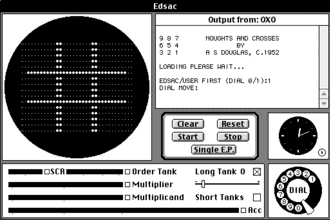
OXO
EDSAC

Gotcha
Arcade

Rally-X
Arcade

Pac-Man
Arcade

Ms. Pac-Man
Arcade
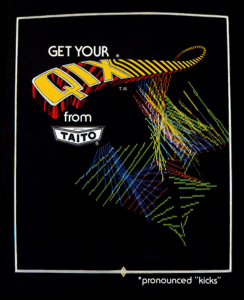
Qix
Arcade

Pengo
Arcade

Q*bert
Arcade

Lode Runner
Apple II / Multiple

Boulder Dash
Atari 8-bit / Multiple

Tetris
Elektronika 60 / Multiple

Solomon's Key
Arcade

Klax
Arcade